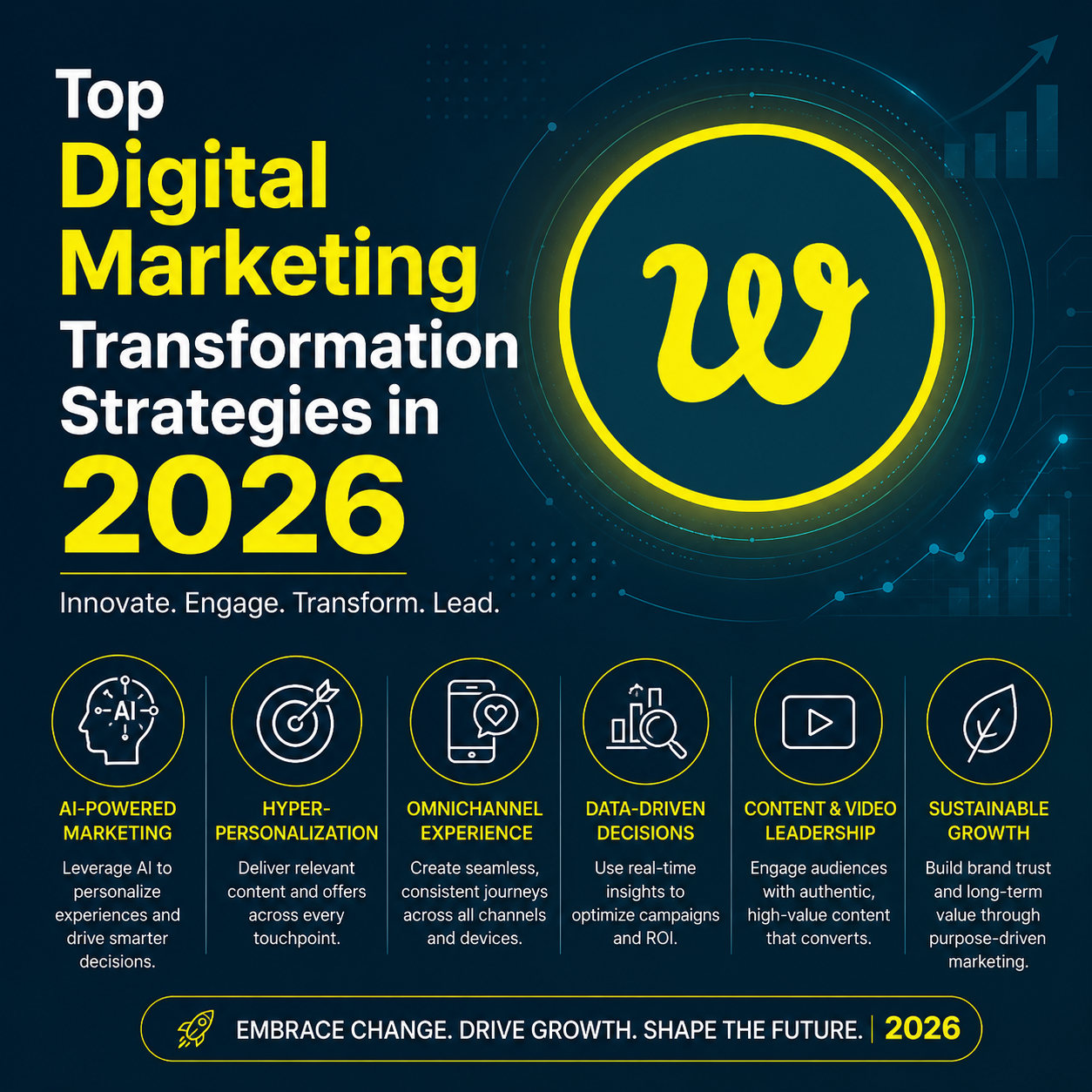
Top Digital Marketing Transformation Strategies in 2026
AI-Powered Digital Marketing Transformation in 2026
The way businesses think about success has changed a lot in the world. Before people looked at things like how many people saw an ad, how many people clicked on it and how many people bought something. Now in 2026 Digital Marketing Transformation is helping companies think about success in a different way. They are looking at things like how much a customer’s worth over their whole lifetime, how likely they are to keep buying from the company and what they are likely to do next. This is changing how companies make decisions about marketing.
AI-powered marketing transformation is also changing how companies work together with their tools and systems. Now all the different systems like customer data platforms, AI-driven CRM systems and automation tools work together in time. This means that companies can see what their customers are doing and make sure they are getting the message everywhere they go whether it is on social media in an email or on their phone. This makes everything work together well and every time a customer interacts with the company it is relevant and makes sense.
The way companies make content has also changed a lot. Now companies can use AI tools to make lots of versions of content that are just right for specific groups of people. This means they can talk to groups of people in a way that is just right for them. They do not have to send out the same message to everyone. This has made it so companies do not have to send out the same old messages all the time. They can always be. Getting better based on what is working and what is not. Next-gen digital marketing transformation is helping companies move away from thinking about individual campaigns and towards always being on and ready to change with what their customers are doing.
Also the way companies make content has become a lot more dynamic. AI tools can now make different versions of content that are personalized for specific groups of people. This lets companies talk to groups of people in a way that is just right for them. Ai- Digital Marketing Transformation is helping companies make content that is tailored to groups of people which is really helpful.
The customer experience is really important to people. These days customers want things to happen away like getting answers to their questions immediately. They also want suggestions that’re just for them and they want to be able to talk to companies in a way that feels smooth and easy no matter how they are talking to them.
Customer experience is what this is about. Companies are using things like computer programs that can talk to people and other computer helpers and special machines that can suggest things to customers.
The customer experience is getting better because of these things. Companies that are using these technologies are getting more people to pay attention to them and more people are buying things from them and customers are staying loyal to these companies.
Marketing Technology Evolution
The basis of marketing is built on the fast changes in marketing technology evolution that have happened over the last ten years. Marketing technology has changed a lot. It used to be simple tools that could send automatic emails. Now it includes systems that use artificial intelligence to manage customer data. The marketing world has become a web of connected technologies. This change has made it possible for companies to watch what people do on different platforms, look at a lot of data and run very targeted advertising campaigns with very little help from people. Marketing technology is still a part of this. It helps companies use marketing technology to get results.
At the heart of this change is Digital marketing transformation. It is changing the way marketers use technology. They are not just using it to help them. To really drive their plans. Digital marketing transformation is using things, like intelligence to make things easier. These tools are helping to make content figure out who the audience is and even guess what they will do. They are also helping to make sure the marketing efforts are working well. These systems get better and better over time. They help make the marketing work efficiently and they help reduce the cost of getting new customers. Next- gen Digital marketing transformation is really important because it is making all of this possible.
Integration of real-time processing is another major change. Marketers are now able to respond instantly to the user’s behavior and adjust campaigns dynamically, based on engagement signals. Marketing is now more intelligent, fluid and adaptive than ever. As part of its broader digital business transformation companies are heavily investing in martech stacks which unify CRM systems with analytics platforms and AI engines.
As marketing technology evolves, organizations are able to gain better Marketing insight. This allows them to not only understand what their customers do, but also why. In a digital marketplace that is highly competitive, this level of understanding will be essential to building long-lasting and meaningful customer relationships.
Online Marketing Modernization
Modernization of online marketing has fundamentally altered the way businesses view digital channels. Websites, search engines, social media platforms and mobile applications no longer stand alone as marketing channels, but are interconnected ecosystems powered by data and automation.
is a key component of this transformation. It plays a crucial role in the redefining of how online campaigns will be structured and executed. Marketers no longer rely on static strategies but instead use AI-powered platforms that optimize ad placements and content formats based on real time performance data.
Both search engine marketing and social network advertising have become more sophisticated. Algorithms prioritize user intent, engagement, and contextual relevance. This forces marketers to focus more on content that is relevant, rather than keyword-stuffing or generic messages. This is a significant shift in marketing digital evolution where relevance and personalization are more important than volume and reach.
Modern online marketing emphasizes omnichannel compatibility. Customers expect seamless experiences on all platforms. Businesses must align messaging, branding and user journeys across all digital touchpoints. This integration is an important component of digital transformation strategy and allows brands to provide a frictionless experience for customers.
Online marketing is not just about being visible; it’s about creating adaptive, intelligent and responsive systems that change with the market and customer trends.
Marketing Technology Evolution is another critical element of this transformation. The use of advanced tools, such as marketing automation software and predictive analytics, allows businesses to gather, analyze and act upon vast amounts of customer data. These technologies allow marketers to better understand the customer journey, identify patterns and deliver highly-targeted campaigns that increase engagement and conversions.
In the addition of digital business, transformation is closely related to how organizations restructure internal processes to support contemporary marketing practices. The teams are no longer isolated; marketing, sales and customer service collaborate with shared data on unified platforms. This alignment improves communication and customer experience, while driving better business outcomes.
The rise of Marketing Innovation Trends such as voice search optimization, AI Chatbots, Augmented Reality (AR), and Interactive Content has further reshaped digital engagement. These innovations enable brands to create memorable experiences beyond traditional advertising by connecting with users more meaningfully and immersively. AI chatbots, for example, provide immediate customer support while AR allows customers to see products before they make a purchasing decision.
This digital Marketing Revolution also has a greater focus on personalization. Brands must understand the preferences, needs, and behaviors of modern consumers. Marketers can use data-driven insights, machine learning algorithms and tailored messages to deliver personalized recommendations, dynamic material and tailored messaging. This level of customization not only increases the customer’s satisfaction, but also creates long-term loyalty to brands.
Modern Marketing Approaches, which place a high priority on authenticity and trust, are another characteristic of modern marketing. Today’s consumers are more discerning and informed, so brands need to be transparent, ethical and customer-centric. Content marketing, influencer partnerships, and user generated content are essential strategies to build credibility and foster genuine connections with audiences.
Marketing insights derived from data analysis are also now at the heart of decision-making. Marketers refine their strategies using real-time dashboards and performance metrics. This data-driven strategy ensures that campaigns can be continuously optimized to achieve better results. It also reduces waste and maximizes return on investment.
Privacy and data protection are also becoming increasingly important to the digital landscape of today. Businesses must prioritize user consent and adopt transparent data practices in light of stricter regulations. Any successful digital transformation strategy must now include a focus on building trust through ethical data use.
The evolution of digital marketing does not only mean adopting new platforms or tools. It is also about adopting a holistic approach that incorporates technology, data, creative thinking, and customer-centricity. The convergence of Modernization of online marketing, Transformation of digital marketing and Evolution in marketing digital will shape a future that is intelligent, personalized and more impactful than any other. Businesses that invest in innovation and adapt to these changes will thrive in a competitive digital landscape.
Digital Business Transformation
In order to expand, organizations also recognize that data integration forms the basis of successful digitalization. Even the most advanced AI can’t deliver meaningful insights without unified data systems. Companies are investing heavily in cloud-based infrastructures, centralized data platforms and customer data platforms to allow seamless data flows across departments. This interconnected data environment allows marketers to create highly-targeted campaigns, while also enabling the leadership team to make strategic decisions based upon accurate and real-time information.
Omnichannel Marketing Strategies are also becoming increasingly important. Consumers today interact with brands across multiple touchpoints–websites, mobile apps, social media, email, and even offline channels. The digital marketing transformation ensures all touchpoints deliver a consistent brand experience. The journey is seamless and personalized whether a customer finds a product on social media or makes a purchase through a mobile application. This increases conversion rates and customer retention.
Automation-driven customer journeys also redefine engagement models. Businesses no longer rely on manual campaign implementation; they instead design automated workflows which respond to user behaviour in real-time. Brands can engage their customers with the correct message at the right time using triggered emails, AI chatbots and dynamic content recommendations. This responsiveness improves efficiency, but it also creates an engaging and relevant experience for customers.
Content Intelligence also plays a growing role. AI tools allow businesses to analyze the best content types, determine audience sentiment and optimize messages accordingly. The data-driven approach ensures that content is not only creative, but also aligned strategically with market trends and audience preferences. This approach reduces the guesswork and allows marketers to concentrate on activities that have a high impact.
Cybersecurity, and data privacy are also essential factors in the digital transformation of business. Maintaining trust is crucial as organizations collect and process large amounts of data from customers. Businesses implement stricter data security measures and adhere to global privacy regulations in order to protect customer information. Transparency is not an option anymore. It is a competitive edge that impacts customer loyalty and brand image.
A new trend in marketing is the integration of augmented reality, and virtual reality. Immersive technologies like these enable brands to provide interactive experiences such as virtual product trial or 3D visualisations. This enhances engagement with customers and bridges the gap that exists between online and off-line experiences.
Conversational artificial intelligence and voice searching are also transforming the way users interact with digital platforms. Businesses are optimizing content to be able to handle voice queries. This shift calls for a new approach in SEO and content strategy that focuses on conversational keywords, user intent and not traditional search patterns.
Agility and adaptability are critical success factors as organizations continue to change. Digital marketing transformation requires constant learning and innovation. It is not a one-time project. Companies that are willing to experiment, use emerging technologies and adapt to consumer changes will be more likely to achieve long-term success.
The convergence of data, technology and customer-centric approaches is redefining business. Digital marketing trends and digital business transformation are driving a dynamic ecosystem that is centered around intelligence, automation and personalization. These elements can help enterprises improve their operational efficiency and build deeper, more meaningful customer relationships in a digital world that is becoming increasingly competitive.
Marketing Innovation Trends
Businesses are also using real time data orchestration in order to improve decision-making for marketing channels. Marketers no longer rely on delayed reports to track campaign performance. Instead, they use AI-driven analytics and live dashboards. This enables immediate optimization–adjusting ad creatives, reallocating budgets, or refining audience targeting without waiting for post-campaign analysis. Modern digital marketing transformation is defined by its responsiveness, which combines speed and precision.
Predictive, and prescriptive analytics are also key developments. Predictive models predict future outcomes using historical data. Prescriptive analytics takes it a step farther by recommending the most effective course of action. Marketers can now not only anticipate their customers’ needs, but also proactively shape the journey of those customers. Brands can, for example, identify customers who are likely to leave and trigger retention strategies like personalized offers or targeted communications.
First party Data strategies that use first-party data are also changing the way businesses operate. Companies are now focusing more on their own data collection and use due to the increasing restrictions placed on third-party cookie usage and stricter privacy laws. Insights gained from loyalty programs, direct interaction, and digital platforms owned by the company are essential. This shift ensures compliance, but also improves the accuracy of data. It allows for more effective personalization.
Generative AI and content automatization redefine creative processes in parallel. Marketers can generate high-quality, mass-produced content, such as blogs, social media updates, ad copy, and video scripts. The real advantage is in combining AI with human creativity. This allows for greater efficiency, while still maintaining emotional connection and authenticity in brand messaging. In a highly saturated content landscape, this balance is essential.
Integration of CX management platforms is another important aspect. These platforms provide a 360-degree perspective of the customer journey by unifying customer interactions across touchpoints. Businesses can use this data to identify pain points, improve user experiences and create seamless interaction that drives satisfaction and loyalty. Marketing is now not just about acquisition, but also retention and long-term engagement.
Digital Marketing Revolution
The Digital Marketing Revolution, which is currently underway, is more than just a technical shift. It represents a fundamental shift in the way businesses view growth and customer engagement. Marketing is not a separate department but a part of the business intelligence and strategy. Marketing is increasingly being aligned with sales, data analytics and customer service in order to create an ecosystem that delivers measurable results and long-term value.
In this revolution Digital Marketing Transformation drives the shift from campaign based thinking to experience based ecosystems. Rather than focusing solely on marketing campaigns, businesses are now designing entire customer journeys based on AI and data insights. These journeys are dynamic and adapt in real-time to the user’s behavior, preferences and intent. This approach allows brands to deliver personalized, consistent experiences across multiple touchpoints including websites, mobile applications, social media and email platforms.
This transformation is deeply linked to the Digital Transformation Strategy where marketing becomes an important pillar for achieving business goals. To gain a deeper understanding of consumer behavior, companies are using advanced technologies, such as machine-learning, predictive analytics and customer data platforms. Decision-making becomes more data-driven as a result. This reduces guesswork and improves campaign effectiveness.
This transformation is deeply linked to the Digital Transformation Strategy where marketing becomes an important pillar for achieving business goals. To gain a deeper understanding of consumer behavior, companies are using advanced technologies, such as machine-learning, predictive analytics and customer data platforms. Decision-making becomes more data-driven as a result. This reduces guesswork and improves campaign effectiveness.
Automation is another important aspect of the Digital Marketing Revolution. Intelligent systems now handle tasks that used to require large teams. For example, ad scheduling, audience segmentation and content optimization. Automation improves both efficiency and accuracy. This allows marketers to react instantly to market changes. This allows professionals to concentrate more on strategy and creativity than on repetitive operational tasks.
Marketing Innovation Trends also influence how brands engage with their audience. Chatbots, voice searches, augmented realities, and AI-generated contents are changing the way brands engage with their audiences. These innovations enable businesses to create immersive, interactive experiences that engage users and foster deeper relationships.
In this changing landscape, privacy concerns and ethical marketing are also a major concern. Businesses must find a balance between transparency and personalization, while ensuring customer data is used responsibly. Companies are being pushed by regulations and consumer awareness to adopt ethical practices. Trust is a key component in modern marketing strategies. Transparency of data usage protects brands against legal risks and also strengthens loyalty among customers.
Modern Marketing Approaches
The move to Modern Marketing Approaches reflects today’s high-competitive digital landscape, which demands agility, intelligence and scalability. Businesses no longer rely on traditional marketing strategies. Instead, they use data-driven frameworks that are powered by automation and artificial intelligence. These advanced systems allow organizations to react quickly to changes in the market while maintaining a consistent brand message across multiple channels. Companies can now deliver more impactful and personalized experiences to their audience.
Digital Marketing Transformation is a key player in this ever-changing ecosystem. It redefines how brands interact and engage with their customers. This allows businesses to go beyond static campaigns, and instead adopt dynamic real-time strategies which are constantly adapted based on performance metrics. Machine learning and predictive analytics algorithms enable marketers to predict customer behavior and optimize campaigns instantly. They can also identify new growth opportunities. Modern digital strategies are characterized by a shift from reactive marketing to proactive marketing.
Marketing Technology Evolution is a new technology that has accelerated the transformation of marketing by introducing sophisticated platforms and tools. Businesses now have access technologies that provide actionable insight and unify data. These include AI-powered analytics dashboards as well as customer data platforms. These innovations are the foundation of Modernization of Online Marketing. Digital channels, such as social media, mobile applications, and search engines are integrated seamlessly to create an unified customer experience.
Digital Business Transformation is also reshaping the entire organization, integrating marketing, sales, customer service and product development. Marketing is not a separate function anymore; it’s deeply integrated into the overall business strategy. This alignment ensures customer-centric approaches at all touchpoints, increasing both engagement and loyalty. This integrated model will help companies compete better in rapidly changing markets.
Marketing Innovation Trends, which emphasize automation, personalization and real-time interaction, are another key driver. Intelligent automation tools are enhancing content marketing, influencer partnerships, and performance advertising. These tools reduce manual work but also improve accuracy in targeting by analyzing large amounts of data. In turn, campaigns are more effective, measurable and result-oriented. This contributes to the digital marketing revolution.
Customer experience is now the core of all marketing campaigns. Businesses invest heavily in technologies to enhance the user experience, from AI-powered chatbots to personalized website experiences. These efforts are supported with continuous marketing insights, derived from behavioral and transactional data. These insights allow companies to better understand their customers’ preferences, predict their future needs and deliver highly relevant information at the right moment.
AI integration has transformed the creative process. Marketers are now able to generate content in large quantities, test different variations of campaigns and optimize messaging real-time. This is a major advancement in marketing digital evolution where data and creativity work together to drive results. AI tools do not replace human creativity, but rather enhance it by providing data backed recommendations and decreasing execution time.
Digital Transformation Strategy is also essential for companies that want to achieve long-term success. This strategy includes adopting advanced technology, restructuring workflows and cultivating a culture that encourages continuous innovation. These strategies make organizations more resilient and adaptable, which allows them to thrive even in unreliable market conditions.
The convergence of New marketing approaches and Digital Marketing Transformation is fundamentally changing the marketing landscape. Businesses that embrace the changes will be able to achieve higher efficiency, greater customer engagement and a stronger competitive edge. Staying aligned with the trends is critical to success in the digital age, as innovation continues to speed up.
Marketing Digital Evolution and Insights
The marketing digital evolution is a constant shift towards intelligent, data driven marketing systems which prioritize efficiency, individualization and measurable results. Artificial intelligence and advanced analytics are being used by businesses to improve marketing performance, gain a better understanding of customers’ behavior and optimize campaigns in real-time. This transformation is strategic and not only technological, as it allows organizations to remain competitive in an ever-changing digital environment.
Digital Marketing Transformation ensures in this evolution that marketing systems no longer are static or campaign-based, but instead are dynamic ecosystems which continuously learn and adjust. Machine learning algorithms use vast amounts of data in order to refine messaging, targeting and channel selection. This adaptability, which is crucial in the fast-paced digital world where consumer expectations and behavior are constantly changing, is vital.
This transformation has led to the creation of enhanced marketing insights that empowers organizations to make data-driven, informed decisions. These insights are derived using real-time transactional and behavioral data. This allows businesses to identify patterns and predict emerging trends and optimize strategies. This allows companies to move away from guesswork and towards precision.
Marketing Technology Evolution also plays a critical role in supporting this change. The use of advanced tools, such as AI-driven analytics and automation systems, allows marketers to create seamless customer experiences by unifying data across all channels. This is the technological advance that drives online marketing modernization. Digital channels are connected and optimized in order to deliver consistent, personalized interactions throughout the customer journey.
Furthermore, marketing innovation trends such as hyper-personalization, predictive engagement, and automated campaign management are redefining how brands connect with their audiences. These innovations are a significant contribution to the digital Marketing Revolution where speed, accuracy and relevance is key. Automation tools streamline execution, but they also boost creativity by allowing marketing teams to quickly test and refine different campaign variations.
Digital Business Transformation is a key component of the digital transformation that organizations are undergoing. This integration allows for a better alignment between organizational goals and customer needs, leading to more effective and cohesive decision-making. Marketing is not an isolated function, but rather a key component to business growth and innovation.
Adopting a digital Transformation strategy will also allow businesses to future proof their marketing. Organizations can be resilient to market disruptions by embracing agile processes and advanced technologies.
Adopting a Digital Transformation strategy will also allow businesses to future proof their marketing. Organizations can be resilient to market disruptions by embracing agile processes and advanced technologies.
This strategy also supports the development of Modern Marketing Approaches where data, creativity and technology combine to deliver exceptional customer experience.
The convergence of Digital Marketing Transformation and data-driven innovations is reshaping marketing. Businesses that adopt these changes and use Marketing insight to their advantage will have a better chance of achieving sustainable growth, stronger relationships with customers, and a long-term competitive edge in the digital age.
Digital Transformation Strategy in Practice
For organizations to be successful in the digital economy of today, a strong Digital Transformation strategy will be essential. This strategy integrates technology, data and AI into all aspects of business operations. Marketing plays a key role.
Digital Marketing Transformation is at the heart of this strategy. It allows businesses to modernize marketing systems and automate intelligent processes. This transformation allows organizations to remain competitive in an ever-changing digital landscape.
Scalability, personalization and automation are the key elements of successful strategies. Businesses can create highly-targeted campaigns that produce measurable results by leveraging AI and data analysis. These strategies support long-term success by improving efficiency and decreasing operational costs.
Moreover, organizations need to constantly adapt their strategies in order to keep up with technological advances. In an increasingly digitalized world, flexibility and innovation are essential to maintain a competitive edge.
Limitations
AI tools need large quantities of high-quality data in order to work effectively. Any compromise on data integrity will have a significant impact on outcomes. Inaccurate targeting, poor personalization and poor decision-making are often the result of outdated or biased data. This has a direct impact on campaign performance and customer confidence. Data bias can also reinforce incorrect assumptions regarding audiences, limiting the diversity and inclusivity of marketing strategies. To combat this, companies must invest in data Governance, audits and data cleansing to ensure accuracy and consistency.
A major obstacle is the high costs of implementing advanced AI marketing systems. The financial burden is significant, from purchasing sophisticated tools to hiring professionals and integrating technology into existing infrastructure. It is especially difficult for startups and small businesses to adopt full-scale marketing systems. The ongoing costs of maintenance, upgrades and training also increase the required investment. Many smaller companies struggle to compete against larger organizations that have access to more resources and advanced technology.
The complexity of deploying AI-based solutions can also create barriers to technical knowledge, and organizational readiness. Many businesses face difficulties in integrating AI into legacy systems and managing data silos. Companies may not be able to maximize AI capabilities without a proper strategy and understanding. This can lead to poor performance and wasted investments. Adopting a clearly defined digital strategy and focusing on scalable options, as well as prioritizing employee education, are all essential steps in maximizing the effectiveness of AI driven marketing initiatives.
Conclusion
Intelligence, automation and data-driven decisions are shaping the future of marketing. Digital Marketing Transformation is becoming more important as organizations embrace new technologies. This is more than a trend, but a fundamental change in the way businesses engage with customers and grow in a digital economy.
In 2026, companies that integrate AI, analytics and automation into their systems will be at the forefront of innovation. The convergence of digital transformation strategy with Marketing technology evolution and advanced Marketing insights creates a powerful ecosystem in which marketing is more personalized, predictive and performance-driven.