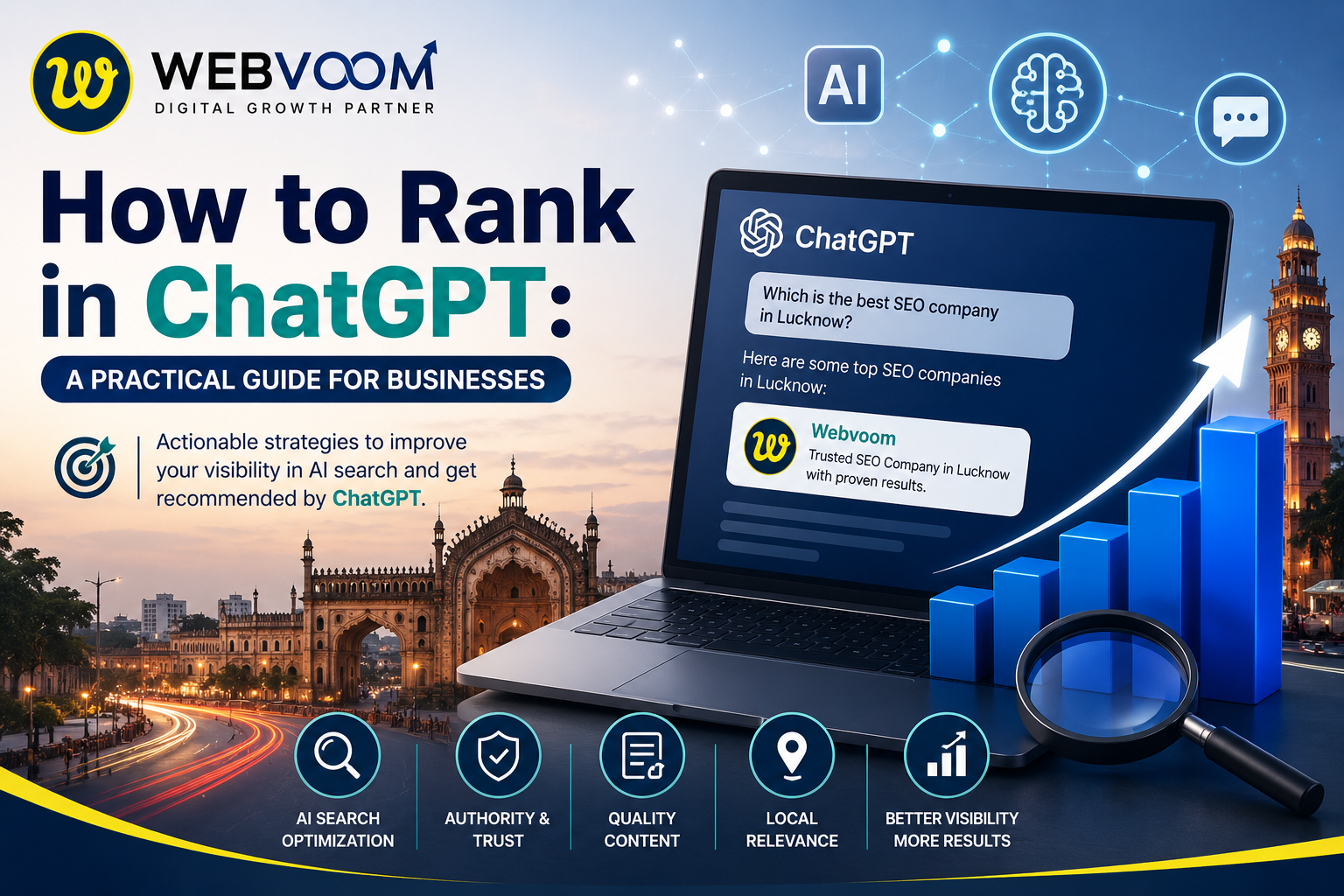
How to Rank in ChatGPT: A Practical SEO Guide
How to Rank in ChatGPT: A Practical Guide for Businesses That Actually Want Results
If you’ve typed “how to rank in ChatGPT” into Google recently, you’re not alone, and you’re already ahead of most business owners who haven’t noticed the shift yet. A shopkeeper in Hazratganj called us last month with a strange complaint. His website was ranking on the second page of Google, which wasn’t great but wasn’t terrible either. His real problem was different. His nephew had asked ChatGPT which packers and movers company to use in Lucknow, and his business didn’t come up at all. Three of his competitors did.
That conversation stuck with us, because it’s happening across every industry right now, not just in Lucknow but everywhere. People aren’t only typing questions into Google anymore. They’re asking ChatGPT, Perplexity, and Gemini the same way they’d ask a well-informed friend. “Which is the best SEO company near me?” “Who does affordable website design in Lucknow?” “Suggest a digital marketing agency that actually delivers.”
If your business isn’t part of the answer, you’re invisible to a growing chunk of your potential customers. And the frustrating part is that most business owners don’t even know this is happening until someone tells them, the way that shopkeeper found out.
This guide is our honest, no-fluff take on how ChatGPT ranking actually works, why it’s different from traditional SEO, and what you can start doing this week to improve your odds. We work on this daily for clients across Lucknow and beyond at Webvoom, so this isn’t theory pulled from a textbook. It’s what we’ve seen move the needle.
Ranking in ChatGPT Isn’t the Same Game as Ranking on Google
Let’s clear up a misconception first. Google ranks pages. ChatGPT doesn’t really rank pages in the traditional sense — it generates an answer, and then decides which brands or sources deserve a mention within that answer. That’s a meaningful difference.
When Google shows you ten blue links, it’s leaving the decision to you. When ChatGPT answers a question like “best web development company in Lucknow,” it’s already made a decision on your behalf and is just telling you the outcome. That puts a lot more pressure on being the obvious, trustworthy choice rather than just the technically optimized one.
Both systems do care about similar underlying signals though — things like how authoritative your content is, how clearly it answers questions, and how consistently your brand shows up across the internet. So this isn’t about throwing out everything you know about SEO. It’s about layering a new set of priorities on top of the old ones.
Why This Matters More for Local Businesses Than People Realize
There’s a common assumption that AI search is only relevant for big national brands with huge marketing budgets. We’d push back on that. If anything, local and regional businesses have more to gain here, because AI tools are increasingly good at handling location-specific queries, and there’s far less competition fighting for that visibility compared to a crowded Google results page.
Think about how many businesses in Lucknow are bidding on the same three or four generic keywords in Google Ads. Now think about how few of them have deliberately built content designed to be picked up and mentioned by ChatGPT. That gap is an opportunity, and it won’t stay open forever. Early movers in any city tend to keep their advantage once AI models start treating them as the “known” answer for a category.
Step One: Stop Publishing Random Blog Posts (Topical Depth Is How You Rank in ChatGPT)
Most websites we audit have a blog that reads like a scrapbook. One post about “10 SEO tips,” another about “why websites need SSL certificates,” a third about some unrelated industry trend — with no thread connecting any of it. That approach might have limped along a few years ago. It won’t help you now.
AI systems, much like search engines, are trying to figure out what your website actually knows a lot about. If your content is scattered, they can’t confidently say your brand is an authority on anything. If it’s focused, the picture becomes obvious.
Say you run a digital marketing agency. Instead of one-off posts, build a genuine cluster:
- What SEO actually costs in India and what affects pricing
- The difference between SEO and paid ads, explained simply
- A breakdown of local SEO for small Lucknow businesses
- How Google Business Profile optimization works
- What makes a website technically “SEO-ready”
- How AI search is changing customer behavior (like this very article)
Every piece links back to the others where it makes sense. Over a few months, this cluster tells both search engines and AI models a very clear story: this business understands digital marketing deeply, not superficially.
Step Two: Write Like You’re Actually Answering Someone, Not Performing SEO
Here’s something we tell every client, even the ones who’ve worked with other agencies before: stop writing content that sounds like it was written to please an algorithm. AI models, ironically, are quite good at spotting hollow, keyword-stuffed writing, and they tend to avoid quoting or citing it.
Picture the actual question someone types into ChatGPT: “Is it worth hiring an SEO agency in Lucknow or should I do it myself?” A generic blog post would ramble about “the importance of SEO in today’s digital age” for three paragraphs before saying anything useful. That’s not going to get picked up in an AI-generated answer.
A better approach gets to the point fast: yes, DIY SEO can work if you have time and patience, but most business owners underestimate how long it takes to see results — usually four to six months minimum — and that’s often where hiring specialists pays off faster than the cost of doing it alone. Notice how that answer doesn’t waste time. It gives a real opinion, backed by a real number, and moves on.
That’s the tone worth aiming for throughout your content. Direct answers first. Context and nuance after. Save the padding for nobody.
Step Three: Build the Kind of Trust That’s Hard to Fake
Both Google and AI tools have gotten noticeably better at sniffing out thin, low-effort websites. If your “About Us” page has three vague sentences and a stock photo, that’s a signal, and not a good one.
Trust signals worth investing in include:
- Real author names and short bios on blog content, not just “Admin”
- Genuine case studies with specific numbers, not vague claims like “we grew their traffic a lot”
- Client testimonials that read like actual humans wrote them
- A physical address and phone number that match across your website, Google Business Profile, and directory listings
- Original photos of your team or office instead of generic stock imagery
- Regularly updated content instead of a blog that hasn’t posted since two years ago
None of this is about gaming a system. It’s about actually being the kind of business that deserves to be recommended. AI models are trained to reflect what’s genuinely credible, so the honest path and the effective path overlap here more than people expect.
Step Four: Structure Your Content So It’s Easier to Rank in ChatGPT
AI tools work by pulling out digestible chunks of information and reassembling them into an answer. If your content is one giant wall of text, there’s nothing clean for it to extract. If it’s broken into clear sections with direct answers, it becomes much easier material to work with.
A few habits that help:
- Open each section with the core answer, then explain the reasoning afterward
- Use descriptive subheadings instead of vague, clever ones — “How much does SEO cost in Lucknow” beats “Let’s Talk Numbers”
- Keep paragraphs short, ideally three to five sentences
- Use bullet points for lists of features, steps, or comparisons
- Include an FAQ section near the end using the exact phrasing people search for
This isn’t about dumbing content down. It’s about respecting the reader’s time, human or machine, and that respect tends to get rewarded with visibility.
Step Five: Match Intent, Not Just Keywords
Old-school SEO obsessed over keyword density. That mindset is genuinely outdated now, and chasing it will waste your time. What matters more is understanding what stage of decision-making someone is in when they ask a question.
Someone typing “what is local SEO” is early in their research and wants an explanation, not a sales pitch. Someone typing “best local SEO company in Lucknow” is much closer to hiring someone and wants comparisons, proof, and confidence. If you write the same generic content for both types of searches, you’ll underperform for both.
A practical way to think about intent:
- Learning stage – they want clear, judgment-free explanations
- Comparing stage – they want honest pros, cons, and differentiators
- Ready-to-buy stage – they want proof, pricing clarity, and an easy next step
Map your content to these stages deliberately, and you’ll notice AI tools start citing you for the right kind of queries instead of random ones.
Step Six: Make Sure Your Brand Shows Up Consistently Everywhere
This part gets ignored constantly, and it’s one of the biggest levers available. AI models build a sense of which brands are “real” and worth mentioning partly by how often and how consistently they appear across the web — not just on your own site.
That means your business name, address, and phone number should match exactly across:
- Your website and service pages
- Google Business Profile
- Justdial, Sulekha, IndiaMART, and other Indian directories
- Guest posts and mentions on other websites
- Social media profiles on Instagram, Facebook, and LinkedIn
Inconsistency, like listing “Webvoom” in one place and “Webvoom Digital Solutions” in another, quietly confuses these systems. It might seem minor, but at scale it genuinely affects whether a model treats your brand as a distinct, recognizable entity.
Step Seven: Create Content That Won’t Expire in Six Months
A lot of blogs lean heavily on trending topics or “2025 statistics” type posts. Fine for a short traffic spike, but they age badly and start hurting credibility once the numbers are stale.
Evergreen formats tend to perform far better over the long run:
- Genuine how-to guides that solve a specific, recurring problem
- Comparison content, like “SEO agency vs. in-house team: which makes sense for small businesses”
- Frameworks and checklists people bookmark and return to
- Honest FAQ pages addressing the questions your sales team hears every week
If you’re only going to invest serious time into a handful of articles this year, make them the ones that will still be accurate and useful two years from now.
Step Eight: Fix the Boring Technical Stuff Too
None of the above matters much if your website is slow, broken on mobile, or structured like a maze. AI crawlers and traditional search bots both need to be able to actually access and parse your content cleanly.
Worth checking:
- Page load speed, especially on mobile connections common across Tier 2 cities
- Clean, logical URL structures
- Proper heading hierarchy (one H1, organized H2s and H3s beneath it)
- Structured data / schema markup, particularly FAQ and Organization schema
- A sitemap that’s actually submitted to Google Search Console
- Internal links connecting related blog posts and service pages to each other
We’ve audited plenty of Lucknow businesses with genuinely good content sitting on a technically broken website, quietly undermining all that effort. Don’t let that be your story.
How Do You Even Measure Whether You Rank in ChatGPT? Tracking AI Search Visibility
One question we get from almost every client once they understand the opportunity is simple: how do I know if any of this is actually working? Fair question, because unlike Google rankings, there’s no neat dashboard yet showing your exact position in ChatGPT’s answers.
That said, there are practical ways to keep a pulse on it. The most direct method is manual testing. Regularly ask ChatGPT, Perplexity, and Gemini the kinds of questions your potential customers would realistically ask, things like “best digital marketing agency in Lucknow” or “affordable website design company near me,” and note whether your brand comes up, how it’s described, and which competitors appear alongside you. Doing this once a month gives you a rough but genuinely useful sense of movement over time.
Beyond manual checks, keep an eye on referral traffic in Google Analytics. AI platforms increasingly send clicks back to source websites, and you’ll start to notice small but real spikes labeled as coming from chat.openai.com or similar sources. It won’t be a flood of traffic in most cases, but even a trickle indicates you’re being cited, which matters more than the raw numbers at this early stage.
It’s also worth watching your Google Business Profile insights, particularly around “how did they find you” data if it’s available, and any anecdotal feedback from customers who mention they found you through an AI recommendation. In our experience, a handful of these conversations tell you more about real-world impact than any single metric.
The honest truth is that measurement in this space is still catching up to the technology itself. Treat it the way smart marketers treated the early days of social media, paying attention to trends and patterns rather than expecting perfectly clean numbers from day one.
Should You Handle This Yourself or Bring in Help?
Plenty of business owners in Lucknow are hands-on by nature, and there’s nothing wrong with attempting this in-house, especially if you enjoy writing and have some patience for the technical side. If you go that route, focus your energy on the two highest-leverage areas first: getting your content genuinely useful and well-structured, and making sure your brand information is consistent across every platform where it appears.
Where most in-house efforts struggle is consistency and technical execution. It’s one thing to write a strong blog post. It’s another to keep publishing at a steady pace for six months while also managing schema markup, internal linking, page speed, and directory listings correctly. That combination of skills rarely sits with one person, which is usually where agencies like ours come in, not to replace the business owner’s voice and knowledge, but to handle the execution and strategy layer around it.
The Mistakes We See Most Often
A few patterns come up again and again with businesses that struggle to gain any AI visibility:
They publish content once and never touch it again, even after Google algorithm updates or new competitors enter the space. They write in a tone that sounds like a brochure instead of a person who actually understands the subject. They ignore their Google Business Profile completely, despite it being one of the strongest local trust signals available. And they treat their website like a static brochure rather than a living resource that keeps answering new questions as they come up.
Fixing even two or three of these consistently, over several months, tends to produce a noticeably different outcome than chasing every new AI SEO trend that shows up in a LinkedIn post.
How Webvoom Approaches This for Lucknow Businesses
At Webvoom, we’ve been building websites and running SEO and digital marketing campaigns for businesses across Lucknow for years, and this shift toward AI-driven search has changed how we plan content strategy for every new client. We don’t treat ChatGPT visibility as some separate add-on service. It’s baked into the same process we already use for solid SEO: understanding your industry, mapping real customer questions, building a content structure around them, and making sure the technical foundation of your site doesn’t get in the way.
Whether you’re a local business trying to compete for attention in a specific Lucknow neighborhood, or a growing brand with ambitions beyond the city, the fundamentals stay the same. Be genuinely useful. Be consistent. Be easy to find and easy to trust, whether the reader is a human scrolling through search results or an AI model deciding who deserves a mention.
Frequently Asked Questions
Does learning how to rank in ChatGPT mean replacing regular SEO?
No, it builds on top of it. A website with weak technical SEO and thin content is unlikely to perform well in AI search either. Think of it as an additional layer of strategy rather than a replacement.
What’s the single fastest way to rank in ChatGPT for a local search?
Get your Google Business Profile fully filled out and consistent with your website, then make sure at least one clear, well-structured page on your site directly answers the exact question customers ask about your service and city. That combination moves the needle faster than almost anything else.
How long does it take to see results in AI search visibility?
Similar to traditional SEO, expect a few months of consistent effort before you notice a meaningful shift. Some brands see early mentions sooner if their existing content and reputation are already fairly strong.
Do I need to create separate content for ChatGPT versus Google?
Not separate content, but the same content written with clearer structure, direct answers, and genuine depth tends to perform well across both.
Can a small local business really compete with big brands in AI search results?
Yes, especially for location-specific queries. Local intent, like “best web design company in Lucknow,” gives smaller, well-optimized businesses a real chance against national players who haven’t focused on local relevance.
How can Webvoom help my business with this?
We handle everything from technical SEO fixes and content strategy to Google Business Profile optimization and ongoing digital marketing, all built around helping Lucknow businesses stay visible as search behavior keeps evolving.
Final Thought
Ranking in ChatGPT isn’t a trick you apply once and forget about. It rewards the same things that have always mattered in good marketing — being clear, being credible, and being genuinely useful to the person on the other end of the question. The businesses that treat this seriously now, rather than waiting until it feels urgent, are the ones that will be the obvious answer when their customers start asking AI tools instead of typing into a search bar.
If you’d like help figuring out where your website currently stands and what it would take to start showing up in these AI-generated answers, reach out to Webvoom. We’re based right here in Lucknow, and this is exactly the kind of work we do every day.