B2B Ecommerce SEO Services – Rank & Convert
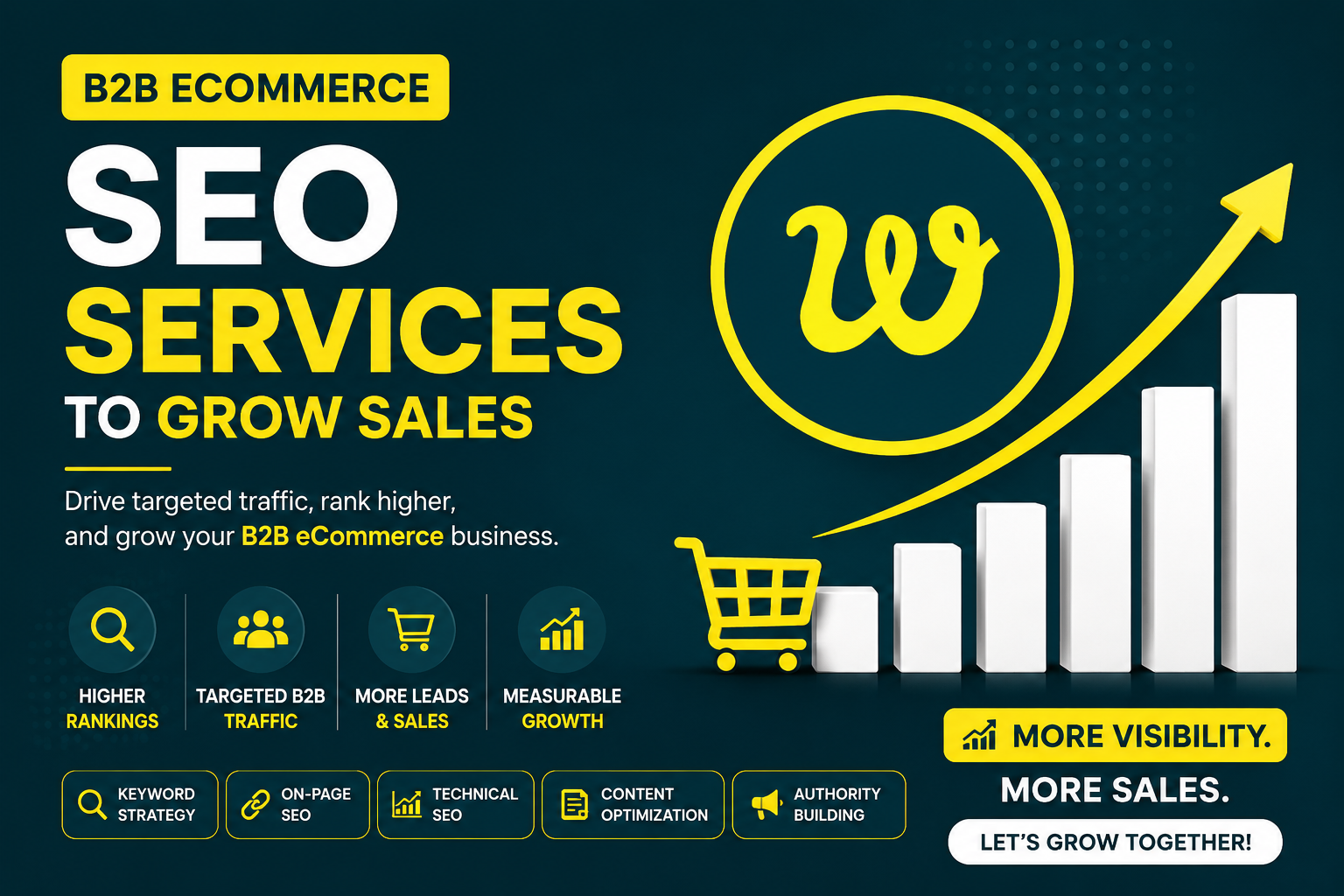
B2B Ecommerce SEO Services to Grow Sales
If you’re running a B2B ecommerce business, you already know the game is different from B2C. Your buyers aren’t making impulse purchases — they’re researching, comparing vendors, checking reviews, looping in three other decision-makers, and taking their sweet time before they ever click “request a quote.” So if your website isn’t showing up when they’re doing all that research, you’re losing deals before you even know they exist.
That’s where B2B ecommerce SEO services come in. Done right, SEO doesn’t just bring traffic — it brings the right traffic: procurement managers, buyers, and business owners who are actively searching for what you sell.
In this post, we’ll break down what B2B ecommerce SEO actually involves, why it looks different from regular ecommerce SEO, and how a dedicated agency like Webvoom approaches it to help B2B brands turn organic search into a real, predictable sales channel.
Why B2B Ecommerce SEO Is a Different Beast
A lot of business owners assume SEO is SEO — optimize some pages, build some links, wait for rankings. But B2B ecommerce has its own quirks that make a generic approach fall flat.
Longer sales cycles. A B2C shopper might buy a t-shirt in two minutes. A B2B buyer might spend weeks or months researching before they even talk to sales. Your SEO strategy has to account for every stage of that journey — not just the “buy now” keywords.
Multiple decision-makers. In B2B, you’re rarely selling to one person. There’s a researcher, a budget holder, an end user, and sometimes a procurement team, all with different questions. Your content needs to speak to all of them.
Niche, lower-volume keywords. Unlike consumer products with millions of monthly searches, B2B keywords are often narrow and technical. Ranking for “industrial grade stainless steel fasteners bulk supplier” might only get 40 searches a month — but those 40 searches are gold if they convert.
Complex product catalogs. B2B ecommerce sites often have thousands of SKUs, variants, and technical specs. Structuring that for both search engines and human buyers takes real strategy.
This is exactly why generic SEO advice doesn’t cut it, and why more B2B companies are turning to specialized B2B ecommerce SEO services instead of trying to DIY it or hire a general marketing freelancer.
What Good B2B Ecommerce SEO Actually Includes
Let’s get practical. Here’s what a solid B2B ecommerce SEO strategy actually looks like when it’s built to grow sales, not just rankings.
1. Deep Keyword Research (Beyond the Obvious)
Good B2B SEO starts with understanding how your buyers actually search — not just for products, but for solutions to problems. That means going beyond “buy [product] online” and digging into:
- Problem-aware searches (“how to reduce downtime in manufacturing equipment”)
- Comparison searches (“[Brand A] vs [Brand B] for bulk ordering”)
- Technical/spec-driven searches (“ISO certified packaging suppliers”)
- Bottom-funnel searches (“request quote for industrial adhesives”)
Each of these needs different content, and mapping them out properly is one of the first things a specialized agency will do before touching a single page.
2. Technical SEO That Can Handle Big Catalogs
B2B ecommerce sites tend to be large — hundreds or thousands of product pages, category pages, and filters. Without proper technical SEO, search engines get confused, crawl budgets get wasted, and pages that should rank end up buried.
Key technical priorities include:
- Clean, logical site architecture (so Google — and buyers — can actually find things)
- Proper handling of duplicate content from product variants and filters
- Fast page speed (B2B buyers bounce just as fast as anyone else)
- Mobile optimization (yes, even procurement managers browse on their phones)
- Structured data / schema markup for products, pricing, and reviews
3. Content That Matches Buyer Intent at Every Stage
This is where a lot of B2B ecommerce sites fall short. They have product pages, sure, but nothing to capture buyers who are still in the research phase.
A strong content strategy fills that gap with:
- Buying guides and comparison pages
- Case studies and use-case content
- FAQ and spec-heavy pages that answer technical objections
- Blog content that targets top-of-funnel, problem-aware searches
The goal is simple: show up at every point in the buyer’s journey, not just at the very end when they’re ready to purchase.
4. On-Page Optimization for Category and Product Pages
Every category and product page is a potential ranking opportunity — if it’s optimized properly. That means:
- Unique, keyword-rich titles and meta descriptions (not templated junk)
- Descriptive product copy instead of manufacturer boilerplate
- Optimized headings, image alt text, and internal linking
- Clear calls-to-action suited to B2B buyers (request a quote, download spec sheet, talk to sales)
5. Link Building and Authority Signals
In B2B, trust matters even more because purchase decisions carry real business risk. Building topical authority through industry publications, supplier directories, partnerships, and digital PR helps establish the credibility that B2B buyers look for before they commit.
6. Conversion Rate Optimization (CRO) Alongside SEO
Traffic without conversions doesn’t grow sales — it just grows your analytics dashboard. That’s why the best B2B ecommerce SEO services don’t stop at rankings. They also look at:
- How easy it is to request a quote or place a bulk order
- Whether pricing and MOQs (minimum order quantities) are clear
- Trust signals like certifications, testimonials, and case studies
- Site speed and checkout/inquiry friction
Why Webvoom’s Approach Works for B2B Ecommerce Brands
At Webvoom, the philosophy is straightforward: SEO should be judged by revenue impact, not vanity metrics. A lot of agencies will hand you a report full of rankings and traffic graphs and call it a win. Webvoom takes it further by connecting SEO directly to pipeline and sales outcomes — because at the end of the day, that’s what actually matters to a B2B business.
Here’s what typically sets Webvoom’s process apart when working with B2B ecommerce clients:
Industry-specific research first. Before any optimization happens, Webvoom digs into how your specific buyers search — whether that’s manufacturers, wholesalers, distributors, or industrial suppliers. Generic keyword tools only get you so far in niche B2B spaces.
Technical audits built for scale. Large product catalogs need a technical foundation that can handle thousands of pages without cannibalizing rankings or wasting crawl budget. Webvoom’s technical audits are designed around this complexity, not a basic 20-page brochure site.
Content mapped to the full buying committee. Instead of only writing for the end buyer, Webvoom builds content that speaks to researchers, budget approvers, and technical evaluators — because in B2B, ignoring any one of them can stall a deal.
Ongoing optimization, not a one-time project. SEO isn’t “set it and forget it,” especially in competitive B2B niches. Webvoom treats it as an evolving strategy, adjusting based on real performance data, seasonal shifts, and changes in buyer behavior.
Sales-aligned reporting. Instead of just showing traffic numbers, Webvoom ties reporting back to leads, quote requests, and revenue — so you always know what your SEO investment is actually producing.
If you’re a B2B ecommerce brand trying to figure out whether SEO is worth the investment, this kind of sales-first approach is what makes the difference between “we got more traffic” and “we got more customers.”
Common Mistakes B2B Ecommerce Brands Make with SEO
Even brands that invest in SEO often see underwhelming results because of a few recurring mistakes:
Copy-pasting manufacturer descriptions. If ten other suppliers have the exact same product description as you, Google has no reason to rank your page over theirs.
Ignoring long-tail, low-volume keywords. In B2B, the “boring” niche keyword with 30 monthly searches often converts better than a broad term with 3,000 searches and zero buying intent.
Treating SEO as a one-time project. SEO compounds over time. Brands that stop after three months and expect lasting results usually get discouraged for the wrong reasons.
No content for the research phase. If your site only has product pages and nothing else, you’re invisible to buyers who are still comparing options.
Weak internal linking. With large catalogs, poor internal linking means your best pages don’t get the authority they deserve from your other content.
Avoiding these mistakes alone can meaningfully improve how your site performs — but pairing that with a dedicated strategy is what actually moves the needle on sales.
How to Know If You Need Dedicated B2B Ecommerce SEO Services
Not sure if it’s time to invest? A few signs it’s worth exploring:
- Your organic traffic is flat or declining despite adding new products
- Competitors consistently outrank you for category and product terms
- You’re relying almost entirely on paid ads or referrals for leads
- Your site has technical issues you don’t have the in-house expertise to fix
- You have content, but it’s not driving inquiries or quote requests
If any of these sound familiar, it’s a strong signal that a specialized approach — rather than a generic SEO checklist — is what your business needs.
Final Thoughts
SEO for B2B ecommerce isn’t about chasing rankings for their own sake. It’s about making sure the right buyers — the ones with real budgets and real intent — find your business at exactly the moment they’re looking for a solution you provide.
That takes more than basic on-page tweaks. It takes deep keyword research built around how B2B buyers actually think, technical SEO that can handle large catalogs, content that speaks to every person in the buying committee, and reporting that ties back to actual revenue.
That’s the kind of approach agencies like Webvoom bring to the table — treating B2B ecommerce SEO services not as a checkbox, but as a genuine growth channel for your business.
If your B2B ecommerce site isn’t showing up where your buyers are searching, that’s not a small leak — it’s lost revenue every single month it goes unaddressed. The good news? It’s fixable, and the sooner you start, the sooner it compounds in your favor.
Faq’s
1. What are B2B ecommerce SEO services?
They’re SEO strategies designed specifically to help B2B online stores rank higher, attract qualified buyers, and generate more sales.
2. How is B2B ecommerce SEO different from regular ecommerce SEO?
B2B SEO targets longer sales cycles, multiple decision-makers, and niche technical keywords instead of quick, impulse-driven searches.
3. How long does B2B ecommerce SEO take to show results?
Typically 3–6 months for initial traction, with stronger results building over 6–12 months.
4. Do I need SEO if I already run paid ads?
Yes — SEO builds long-term, sustainable traffic and reduces dependency on rising ad costs.
5. What’s included in B2B ecommerce SEO services?
Keyword research, technical SEO, content strategy, on-page optimization, link building, and CRO.