
Local SEO for Dentists: How to Rank & Win More Patients
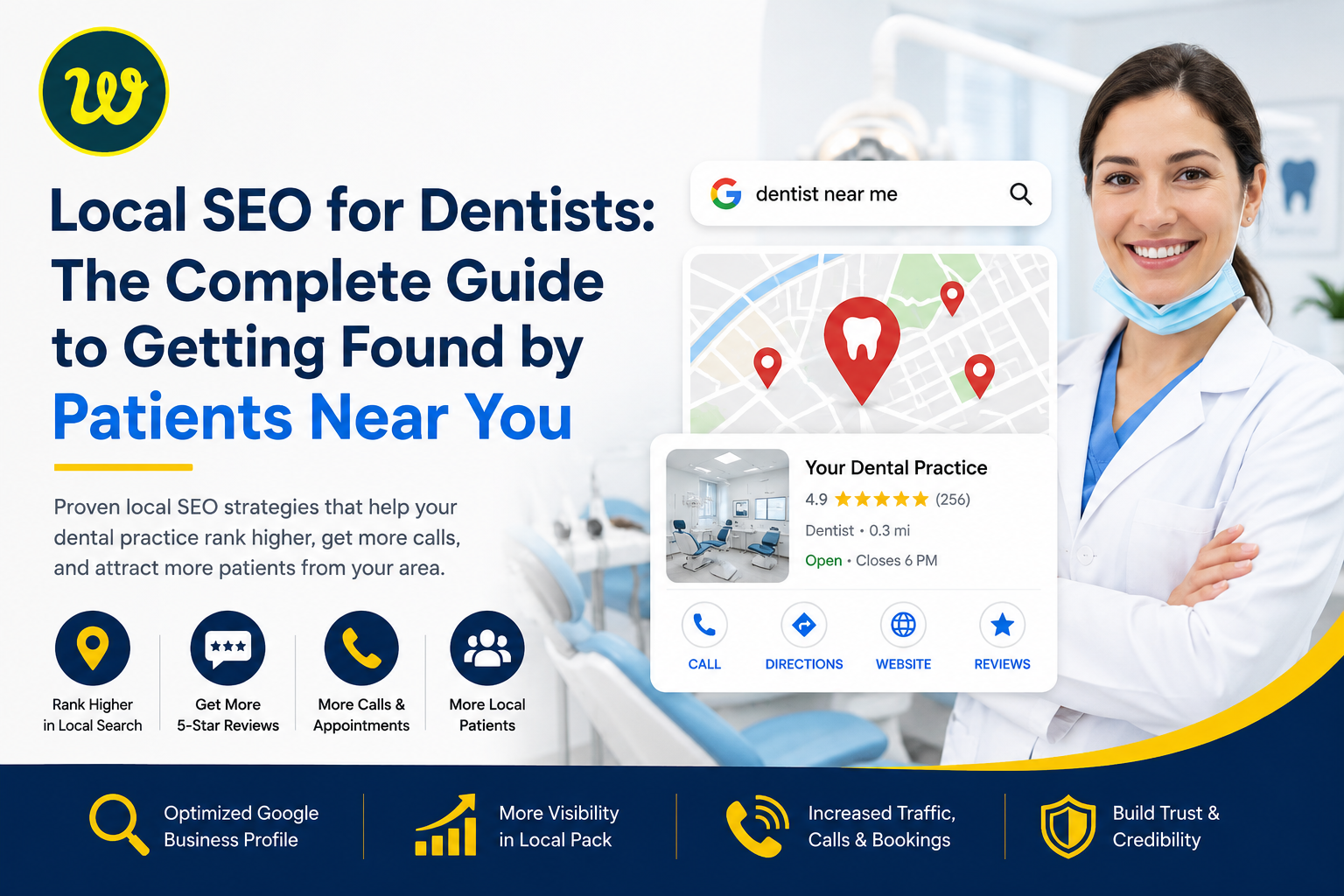
Local SEO for Dentists: The Complete Guide to Getting Found by Patients Near You
Picture this: someone in your city just chipped a tooth, or their kid needs a first checkup, or they finally decided to deal with that gum sensitivity they’ve been ignoring. They don’t ask a friend for a recommendation anymore. They pull out their phone and type “dentist near me.” Within seconds, Google hands them three options in the map pack and a handful more just below it. If your practice isn’t one of them, you don’t lose that patient to a better dentist — you lose them to whoever showed up first. That’s the entire game behind local SEO for dentists. It’s not an abstract marketing concept. It’s the practical work of making sure Google, and increasingly AI tools like ChatGPT and Gemini, can find your practice, understand what you offer, and trust you enough to recommend you over the five other dental offices within a two-mile radius.
Google handles the overwhelming majority of search traffic worldwide, and mobile click-through data tells a blunt story: the first position in a local pack captures roughly ten times the clicks that position ten gets, and barely half a percent of searchers ever bother clicking through to page two. In other words, “ranking somewhere” isn’t good enough. You need to be in the handful of spots patients actually see.
This guide walks through what local SEO for dentists actually means in 2026, why it’s changed, and the specific, doable steps that move the needle — without requiring a marketing degree or an agency retainer the size of a mortgage payment.
Why Local SEO for Dentists Matters More Than Ever
General SEO and local SEO for dentists are not the same discipline, and mixing them up wastes a lot of practices’ time. You could rank nationally for “dental implants” and still lose every local patient because you never built the signals that actually matter for someone searching with a city name or “near me” attached to their query.
Dental care is inherently local — nobody drives across the state for a routine cleaning. Patients want proximity, credibility, and speed. They want someone close, someone with solid reviews, someone who takes their insurance, and ideally someone who can see them this week if a molar starts throbbing at midnight.
There’s also an emotional layer that a lot of local SEO advice skips over. Choosing a dentist is a health decision, often carrying real anxiety. A complete, well-reviewed, actively maintained online presence does a lot of quiet trust-building before the phone ever rings — which is exactly what local SEO for dentists is designed to support.
Understanding How Local SEO for Dentists Works
Google’s local ranking system leans on three factors: relevance, distance, and prominence. Relevance is how well your practice matches the search — a page that never mentions “emergency appointments” won’t surface for “emergency dentist,” even if you offer same-day care. Distance is simply how close you are to the searcher. Prominence is the reputation layer: reviews, citations, backlinks, and how complete and active your listings are.
It helps to think about local search in three tiers rather than one blurry category. **Hyperlocal** search reflects visibility right at your practice’s doorstep — someone standing a block away searching “dentist.” **Local** search covers your broader service area, the map pack results someone across town would see. **Local organic** search is the blue-link results below or beside the map, driven by how well your actual website is built and written. A practice can be strong in one tier and invisible in another, which is why a single Google Business Profile fix rarely tells the whole story.
Google Business Profile: The Foundation of Local SEO for Dentists
If there’s one thing to get right before anything else, it’s your Google Business Profile. It’s often the very first thing a prospective patient sees, sometimes before they ever land on your website, and it frequently decides whether they call you or the practice next door.
A properly optimized profile has your real practice name (no keyword stuffing), an address and phone number that match your website exactly, accurate hours including holidays, and every relevant category selected — not just “Dentist,” but “Cosmetic Dentist,” “Pediatric Dentist,” or “Emergency Dental Service” where they genuinely apply. Fill out the services section with what patients actually search for: teeth cleaning, dental implants, root canals, clear aligners, emergency care, rather than vague catch-all terms.
Photos matter more than most practices realize — real shots of the office, the team, and treatment rooms consistently outperform a single stock image or an empty gallery. And don’t treat the profile as a one-time setup task. Posting updates, answering questions in the Q&A section, and keeping information current all signal to Google that the listing is active and trustworthy, which directly supports the “prominence” factor in the ranking equation.
Key Local SEO for Dentists Strategies That Actually Work
Once your profile is solid, the next layer is your website, your citations, your reviews, and your content — the four pillars that reinforce each other.
On-Page Optimization for Local SEO for Dentists
Your website needs to speak the same language as the searches you want to win. That means your city and service area should appear naturally in page titles, headers, meta descriptions, and body copy — naturally being the operative word. Stuffing “dentist in [city]” into every paragraph reads badly to human visitors and gets flagged as spam by search engines.
A single homepage mentioning a service once won’t build enough context for Google to rank it. What actually works is building topical authority: create one strong, detailed page for a core service (say, dental implants), then support it with related pages — implant recovery, cost and financing, who’s a good candidate — all linking back to that main page. This mirrors how well-structured reference sites earn authority: a solid anchor page surrounded by genuinely useful supporting content, rather than ten thin pages all fighting for the same keyword.
Your contact page deserves more attention than most practices give it. Include a crawlable address (not a screenshot of a map), an embedded Google Map, and a phone number in actual text so search engines can read it. Page speed and mobile-friendliness round out the basics — a large share of local searches happen on a phone, often from someone in pain looking for same-day help, and a slow-loading “book now” button costs you that patient before they see anything else.
Citations, NAP Consistency, and Where Backlinks Actually Fit
A citation is any mention of your practice’s name, address, and phone number (NAP) on another site — Healthgrades, Zocdoc, Yelp, or a dental association directory, for example. Google treats these as a cross-check on whether your practice is real and located where you say it is.
Consistency is what makes citations valuable. If your Google Business Profile lists “123 Main Street, Suite 4” and Yelp says “123 Main St #4,” that mismatch quietly erodes trust signals. It sounds nitpicky, but search systems are precise, and small inconsistencies compound across dozens of directories.
It’s worth separating citations from backlinks, since they do different jobs. A citation confirms your business exists and where it’s located. A backlink — a local news article, a chamber of commerce page, a school partnership mention — passes along authority and shows you’re genuinely connected to your community. For many single-location practices in less competitive markets, citations and a strong Google Business Profile carry more weight than an aggressive backlink campaign. In tighter, more saturated markets, local backlinks start to matter more.
Reviews and Reputation as Part of Local SEO for Dentists
Reviews are the single most persuasive factor for a patient on the fence, and they’re a real ranking signal too. A practice with 150 reviews at 4.8 stars will consistently beat one with a dozen reviews and a 3.9 average.
Generating them doesn’t require anything clever — it requires asking, consistently, right after a good visit when the experience is still fresh. A simple text or email with a direct link to your Google review page removes friction and dramatically increases response rates. Avoid incentivizing reviews or cherry-picking who gets asked; platform policies and basic ethics both rule that out.
How you respond matters just as much. A thoughtful, professional reply to a negative review — without discussing treatment specifics or patient details publicly — builds more trust than ignoring it, because it shows future patients how you handle problems. A generic, warm response works fine for positive reviews too: specific enough to feel genuine, general enough to protect privacy.
Content Marketing That Supports Local SEO for Dentists
Blog content gives you more entry points into search results and demonstrates real expertise. Write about what your front desk already answers on the phone every day — what to expect at a first visit, whether you take a specific insurance plan, when to bring a toddler in for their first checkup. This does double duty: it reduces repetitive calls for your staff and gives search engines fresh, genuinely useful pages to index.
Weave in local relevance where it fits naturally — a seasonal care post referencing local school schedules, an emergency-care page noting how quickly patients in your area typically get seen. Short video also helps more than people expect: a quick office tour or a dentist’s self-introduction keeps visitors on the page longer, which is a small but real trust signal.
Local Backlinks and Community Signals
Local backlinks are worth pursuing even without a formal campaign. Sponsoring a youth sports team, partnering with a school for a dental health day, or getting mentioned in a local news roundup all earn links from sources search engines already treat as credibly local. Chamber of commerce listings and community event pages aren’t glamorous, but they reinforce the same signal your citations and reviews send: that your practice is a real, active part of the community it serves.
How AI Search Is Changing Local SEO for Dentists
Patients increasingly ask AI tools questions instead of typing short keywords — “which dentist near me takes new patients and offers Saturday appointments” instead of “dentist near me.” Google’s AI Overviews and AI Mode can summarize answers directly in search results, and tools like ChatGPT, Gemini, Claude, and Perplexity may pull from web content, business listings, and reviews when patients ask for recommendations.
This doesn’t replace traditional local SEO for dentists — it sits on top of it. A practice with a complete, accurate Google Business Profile, clear service pages, and consistent citations across the web gives these systems more context to recognize it as a real, trustworthy local entity. Practically, this means writing content that answers patient questions directly and clearly, using descriptive headings, and keeping your practice’s name, address, services, and providers identical everywhere they appear online. The clearer and more consistent your digital footprint, the easier it is for both Google and AI tools to vouch for you.
Common Mistakes to Avoid in Local SEO for Dentists
A handful of mistakes show up again and again. Duplicate or outdated listings — an old Yelp page from a previous office manager, a forgotten second Google Business Profile — confuse both patients and search engines and can actively hurt rankings. Neglecting mobile users is another: a clunky booking form or a click-to-call button that doesn’t actually dial loses patients who won’t bother switching to a desktop.
Ignoring reviews, good or bad, signals neglect. So does treating local SEO as a one-time project rather than ongoing maintenance — while your practice sets it and forgets it, competitors keep collecting reviews and posting updates every month, and local rankings are relative to what everyone else in your area is doing.
One subtler mistake: handing everything to an agency and never checking in. Agencies genuinely help with technical work, but the practices that see the best results still stay involved — reviewing new content before it publishes, making sure their voice comes through, and confirming reported “wins” translate into real calls and booked appointments rather than vanity metrics on a monthly report.
Should You Handle It Yourself or Bring in Help?
A small, single-location practice with some internal time can realistically manage the basics — profile updates, review requests, simple content. Professional support tends to make more sense once you have multiple locations, technical website issues, inconsistent citations across dozens of directories, or aggressive local competition eating into your visibility.
If you do bring in help, look for a provider who can clearly explain how they’ll optimize your Google Business Profile, audit citations, structure service and location pages, manage reviews ethically, and measure results against calls and booked appointments — not just rankings on a report. Be wary of anyone promising guaranteed rankings; no one controls Google’s algorithm or what competitors do next.
A Simple 90-Day Local SEO for Dentists Action Plan
Trying to fix everything at once is overwhelming, so a phased approach works better. In the first 30 days, focus on accuracy: confirm your practice name, address, phone number, hours, categories, and services match everywhere, and make sure your core website pages are actually indexable by search engines.
From day 31 to 60, improve the pages patients actually use to decide — each core service page should explain the treatment, who it’s for, what to expect, and how to book, with a steady cadence of review requests going out to recent patients.
From day 61 to 90, build authority: add structured data (schema markup) so search engines can read your business details more precisely, tighten internal linking between your pillar and supporting pages, earn a few genuine local citations or backlinks, and start publishing content that answers real patient questions.
How to Measure Local SEO for Dentists Success
Track your Google Business Profile insights — direct versus discovery searches, direction requests, calls placed straight from the listing. Watch rankings for realistic terms like “[your city] dentist” or “family dentist near [neighborhood]” monthly rather than daily, since day-to-day fluctuation is normal and checking too often just creates stress.
Your new-patient intake form is an underused data source. Adding a simple “How did you hear about us?” field, and actually reading the answers, tells you far more about whether your online visibility is converting into real appointments than any ranking report will.
How Webvoom Can Help You Rank for Dentist in Lucknow with Their Local SEO Services
Everything above is the roadmap. Actually walking it — while also running a busy practice — is a different story, and this is where a market that looks like Lucknow adds its own wrinkle. Lucknow isn’t a small town with three dental clinics competing for attention; it’s a sprawling, fast-growing city with dense clusters of practices around areas like Gomti Nagar, Hazratganj, Aliganj, Indira Nagar, and Alambagh, each with its own competitive intensity and patient search behavior. Ranking for “dentist in Lucknow” as a broad term is a different challenge than ranking for “dentist in Gomti Nagar,” and most practices don’t have the bandwidth to figure out that distinction while also seeing patients all day.
This is the gap Webvoom is built to close. Rather than applying a generic local SEO for dentists template to every client, Webvoom starts by mapping the actual competitive landscape in Lucknow — who’s currently occupying the map pack for the searches that matter to your specific location and specialty, what their citation and review profiles look like, and where the realistic openings are for a practice like yours.
From there, the work follows the same fundamentals covered throughout this guide, but tuned specifically to the Lucknow market. Webvoom optimizes and actively manages your Google Business Profile with categories, services, and photos that reflect how Lucknow patients actually search, rather than a one-size-fits-all setup. On the website side, they build and structure location- and service-specific pages — a dedicated page for a Gomti Nagar clinic reads differently from one for a Hazratganj branch, and Google rewards that specificity far more than a single generic “contact us” page trying to cover the whole city.
Citation building is handled with the same precision that matters everywhere but especially in a market with this many practices competing for the same map pack slots: consistent NAP details across Indian and international directories relevant to healthcare and dentistry, so there’s no ambiguity for Google about who you are or where you’re located. Review generation gets built into a repeatable system — prompting satisfied patients at the right moment, responding professionally to every review, and steadily building the kind of review volume and rating that outweighs a competitor’s five-year head start.
Webvoom also brings the newer layer covered earlier in this guide — visibility in AI-driven search and answer engines — into the same strategy, so a Lucknow practice isn’t just optimizing for today’s map pack but for how patients are increasingly asking AI tools for dentist recommendations nearby. The result isn’t a one-time ranking bump; it’s a maintained, monitored local SEO for dentists program built around Lucknow’s actual search landscape, with regular reporting tied to calls and booked appointments rather than vanity metrics.
Bringing It All Together
Local SEO for dentists in lucknow isn’t a single tactic to check off once — it’s an ongoing relationship between your practice and the patients searching for care nearby. The practices that consistently show up at the top of local search results aren’t necessarily the most skilled clinicians in town, though that certainly helps. They’re the ones who took the time to make their online presence accurate, active, and genuinely useful to the people looking for them, in a form that both Google and the AI tools patients are starting to lean on can actually understand.
Start with the fundamentals: a fully optimized Google Business Profile, consistent citations, and a steady stream of genuine reviews. Layer in a website built around real patient questions rather than keyword density, and keep the whole system maintained instead of treating it as a one-and-done project. Do that consistently, and the map pack, the organic results, and the steady stream of new patients calling your office will follow.