Understanding Google AI Overview Ranking Factors (2026)
Google AI Overview Ranking Factors 2026
Google’s AI Overview has changed how millions of people find answers online. Instead of scrolling through ten blue links, searchers now see a synthesized summary right at the top of the page — often before they even glance at a single website. For content creators and SEOs, this shift raises one urgent question: what actually gets a page featured?
Understanding Google AI Overview ranking factors is no longer optional. Whether you run a blog, manage an e-commerce site, or handle content strategy for a business, knowing how this system selects and cites sources can directly affect your traffic, visibility, and authority in 2026.
This guide breaks down exactly what influences inclusion, how it differs from traditional SEO, and what you can start doing today to improve your odds of being featured.
What Is Google AI Overview?
Google AI Overview is an AI-generated summary that appears at the top of search results for many queries. It pulls information from multiple web sources, synthesizes it into a coherent answer, and displays it before the standard organic listings. Unlike a simple featured snippet, which quotes a single source, AI Overview often blends and paraphrases content from several pages, then links out to the sources it drew from.
For users, this means faster answers. For website owners, it means a new layer of competition sits between your content and the click you used to get automatically.
Why Google AI Overview Ranking Factors Matter More in 2026
The AI Overview feature has expanded significantly since its initial rollout. It now appears on a much larger share of search queries, spanning informational, commercial, and even some transactional searches. As adoption grows, so does its impact on organic click-through rates.
Sites that appear as cited sources within AI Overviews tend to retain some visibility and brand exposure even when users don’t click through immediately. Sites that are ignored by the system, however, risk losing both the click and the brand impression. This makes understanding the ranking factors behind AI Overview inclusion a priority for anyone serious about search visibility this year.
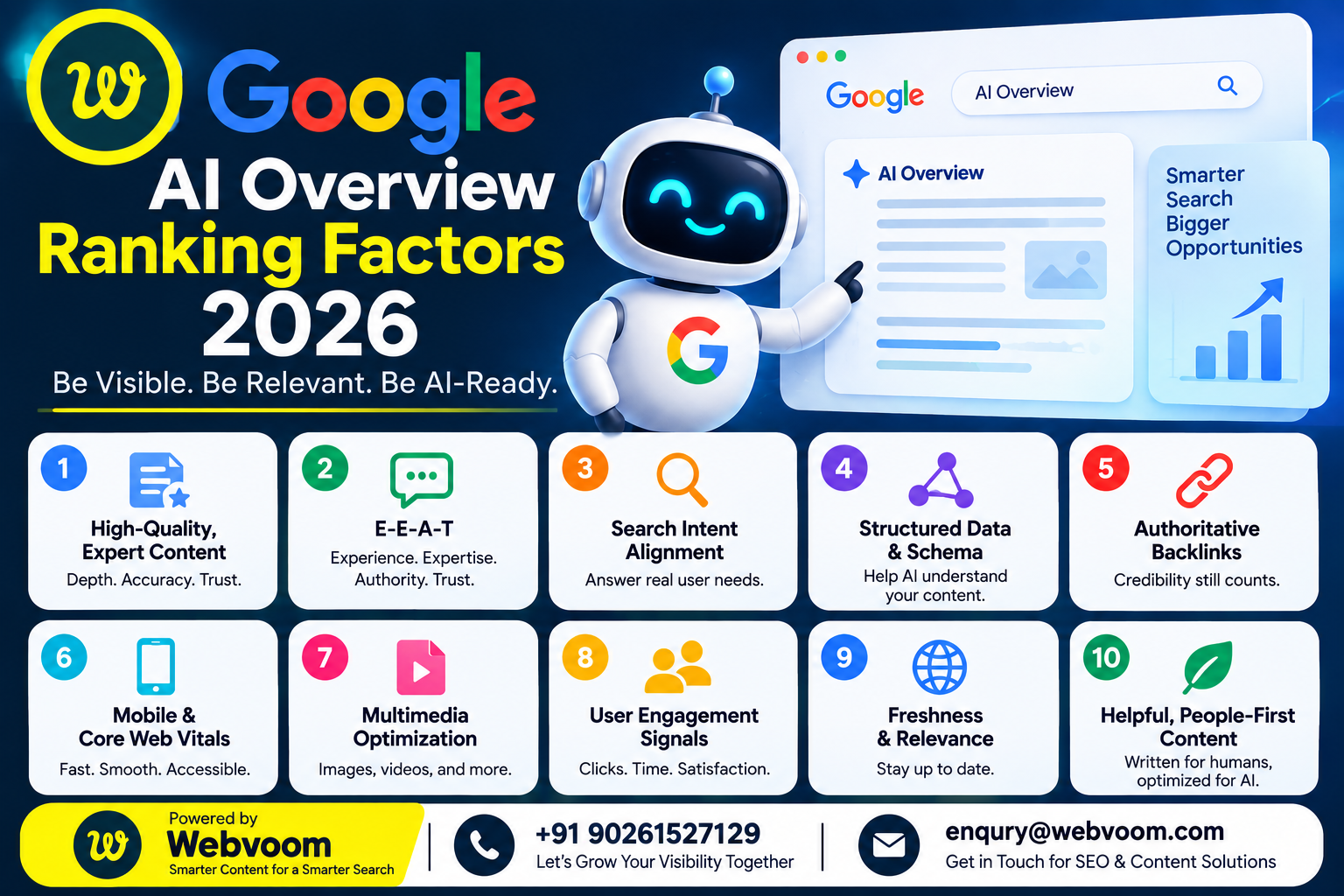
Core Google AI Overview Ranking Factors
1. Strong Existing Organic Rankings
Google’s AI Overview draws heavily from pages that already perform well in traditional search results. Content that ranks on page one for a given query has a significantly higher chance of being pulled into the summary. This means classic SEO fundamentals — keyword relevance, backlinks, and page authority — still form the foundation of AI Overview visibility.
If your content isn’t ranking well organically, it’s unlikely to be selected as a source, regardless of how well-written it is.
2. Clear, Structured Content
AI Overview systems favor content that’s easy to parse and extract information from. Pages with:
- Descriptive headings (H2s and H3s that match user intent)
- Short, focused paragraphs
- Bullet points and numbered lists
- Clear topic sentences
…are more likely to be pulled into a summary than dense, unstructured blocks of text. Structuring your content the way you would for a featured snippet — direct answers near the top, supporting detail below — tends to perform well here too.
3. Direct Answers to Specific Questions
Google’s AI systems are built to extract concise, accurate answers to user queries. Content that explicitly answers a question — ideally within the first few sentences of a section — is more extractable than content that builds up to an answer gradually.
If your post discusses “what triggers Google AI Overview,” for example, answering that question directly and early gives the system a clean, quotable passage to work with.
4. E-E-A-T Signals (Experience, Expertise, Authoritativeness, Trustworthiness)
Google has repeatedly emphasized E-E-A-T as central to its quality systems, and this extends to AI Overview source selection. Content that demonstrates:
- First-hand experience with the topic
- Author credentials or bylines
- Citations to credible data or research
- A trustworthy site reputation (secure, transparent, well-maintained)
…is more likely to be trusted as a source for AI-generated summaries. Anonymous, thin, or unverifiable content is far less likely to be cited.
5. Structured Data and Schema Markup
Structured data helps search engines understand the context and meaning of your content beyond plain text. FAQ schema, HowTo schema, and article schema can make it easier for AI systems to identify direct answers, steps, or definitions within your page.
While schema markup won’t guarantee inclusion, it reduces ambiguity for the crawler and improves the odds that your content is interpreted correctly.
6. Fresh and Updated Content
For topics that evolve quickly — including AI and SEO itself — freshness matters. Google AI Overview tends to favor recently updated content for queries where the answer could change over time. Regularly updating publish dates, statistics, and examples signals that your content remains accurate and relevant.
7. Page Experience and Technical Health
Core Web Vitals, mobile-friendliness, and overall site performance continue to play a role. A page that loads slowly, has intrusive ads, or renders poorly on mobile devices is less likely to be crawled effectively or trusted as a quality source, even if the written content is strong.
8. Natural Language and Conversational Phrasing
Because AI Overview often responds to conversational or question-based queries, content written in a natural, conversational tone — while still being informative — tends to align well with how the system extracts and rephrases information. Overly keyword-stuffed or robotic phrasing can work against you here.
9. Topical Depth and Comprehensiveness
Pages that thoroughly cover a topic, including related subtopics and common follow-up questions, are more likely to be seen as authoritative on that subject. This doesn’t mean padding content with filler — it means anticipating the different angles a user might want answered and addressing them within the same piece or a well-linked content cluster.
10. Backlink Profile and External Validation
Backlinks remain a strong trust signal. Pages that are referenced by other reputable sites are more likely to be viewed as credible sources, both by traditional ranking algorithms and by the systems powering AI Overview.
How Google AI Overview Differs From Featured Snippets
It’s easy to confuse AI Overview with the older featured snippet format, but they work differently:
| Feature | Featured Snippet | AI Overview |
|---|---|---|
| Source count | Single source | Multiple sources |
| Content format | Direct quote | Synthesized/paraphrased summary |
| Placement | Above organic results | Above organic results, often larger |
| Optimization focus | One perfect answer | Structured, comprehensive coverage |
Optimizing for one doesn’t guarantee visibility in the other, but the underlying principles — clarity, structure, and direct answers — help with both.
Does Google AI Overview Reduce Website Traffic?
This is one of the most common concerns among site owners, and the honest answer is: it depends. Early data suggests that AI Overview can reduce click-through rates for certain informational queries, since users get their answer without needing to visit a website.
However, sites that are cited as sources often see:
- Increased brand visibility, even without a click
- Traffic from users seeking more in-depth information than the summary provides
- Potential authority signals that support rankings elsewhere
Rather than viewing AI Overview purely as a traffic threat, it’s more useful to treat it as a new visibility channel that rewards well-structured, trustworthy content.
How to Optimize for Google AI Overview Ranking Factors
Audit Your Existing Content
Start by identifying pages that already rank well organically for target queries. These are your best candidates for AI Overview optimization, since strong existing rankings are a prerequisite for inclusion.
Restructure for Extractability
Add clear headings that mirror real user questions. Break up long paragraphs. Use bullet points for lists and steps. Place direct answers near the top of each section rather than burying them in narrative text.
Strengthen E-E-A-T Signals
Add author bios with relevant credentials. Cite credible sources and data. Make sure your site has clear contact information, an About page, and transparent policies. These trust signals matter more than ever.
Implement Structured Data
Add FAQ schema to sections that answer common questions, and HowTo schema for step-by-step content. This gives search engines additional context beyond the raw text.
Keep Content Updated
Revisit high-value pages regularly. Update statistics, examples, and dates. For fast-moving topics, consider adding a “last updated” timestamp to signal freshness to both users and search engines.
Build Topical Authority
Instead of publishing isolated posts, build content clusters around core topics. Internal linking between related pieces helps establish depth and comprehensiveness, both of which support AI Overview inclusion.
Improve Technical Performance
Run a Core Web Vitals audit. Fix slow-loading pages, optimize images, and ensure mobile responsiveness. Technical health remains a quiet but persistent factor in how much trust search engines place in your site.
Common Mistakes to Avoid
- Keyword stuffing: Overusing your focus keyphrase unnaturally can hurt readability and doesn’t help with AI extraction.
- Ignoring structure: Long, unbroken paragraphs are harder for both users and AI systems to parse.
- Neglecting E-E-A-T: Thin or anonymous content is unlikely to be trusted as a source.
- Set-and-forget publishing: Outdated content loses relevance quickly, especially on fast-changing topics.
- Chasing AI Overview at the expense of users: Content built purely to game extraction, rather than genuinely help readers, tends to underperform in the long run.
Final Thoughts
Google AI Overview ranking factors in 2026 build on familiar SEO fundamentals — authority, structure, trust, and relevance — while adding new emphasis on extractability and conversational clarity. There’s no single trick to guarantee inclusion, but the sites most likely to be featured are the ones that already do good SEO well: clear writing, credible expertise, strong technical performance, and content genuinely built to answer real questions.
Rather than treating AI Overview as a separate discipline, think of it as raising the bar on the same practices that have always mattered in search — just with a sharper focus on clarity and trust.
Faq’s
1. What are Google AI Overview ranking factors?
The signals Google uses to decide which pages get pulled into its AI-generated search summaries — things like good rankings, clear structure, and trustworthy content.
2. How is it different from a featured snippet?
A snippet quotes one source. AI Overview blends info from several sources into one summary.
3. Do I need to rank on page one already?
Usually, yes. Strong organic rankings are one of the biggest Google AI Overview ranking factors.
4. Does schema markup guarantee I’ll get featured?
No, but it helps Google understand your content better, which improves your chances.
5. Will AI Overview hurt my traffic?
It can reduce clicks for simple questions, but being cited still builds visibility and can bring in traffic from people wanting more detail.